Wednesday, June 11, 2014

Ramblin' Man

So it's been about 3 weeks since my last post, which means I'm just that much closer to being a lean, mean Georgian speaking machine (and yet I remain oh so far away). 


Let's kick things off with an oldie but a goodie - Saturday, May 24. I took my first trip over to Surami, a town about 20 minutes away from Gomi known for "nazuki," a bread that tastes like cinnamon and pumpkin and all kinds of deliciousness. Surami is a much larger town than Gomi and is home to two Peace Corps clusters. The main attraction is an old fortress, at the top of which is an amazing view of the town.

One of Surami's churches

Top of Surami's fortress


After exploring the fortress for a little while we took a marshutka over to my friend Nick's house. Although he's technically part of the Surami cluster, his house is in another town about 10 minutes away, and behind his house is a mountain that we wanted to hike. After about 30-45 minutes on a slightly treacherous pseudo-path, we realized it was getting late and that there was no end in sight, so we just turned around and went back down.

Our hike's apex. Our only view was achieved by climbing that tree in the back right.


The following day on Sunday, a few of my Gomi-homies and I walked over to the neighboring town of Vaka for one of our fellow PCV's (Peace Corps Volunteer) birthday. About 15-20 of us gathered in an incredibly picturesque field with a 360 degree view of mountains. We drank, ate, and played frisbee until the weather started taking a turn for the worse. We could see massive rain clouds far off moving in and then starting to rain - as in we could see the entire breadth of a particular rainstorm, which was pretty cool. 

Surrounded by mountains, as is the (awesome) case in most of Georgia


During the following week we had a hub day and permanent site placement interviews. Hub days are when both English Education volunteers and Individual and Organizational Development volunteers have training together. There are about 40 EE and 15 IOD volunteers in my group. These are the only areas in which the Peace Corps serves in Georgia, while in other countries volunteers can serve in other capacities, such as in agricultural, health, or environmental roles (all of which I believe require more technical backgrounds). I brought my external hard drive to hub day and thanks to other generous volunteers I now have enough TV shows, movies, and books to last beyond the duration of my service. As for my permanent site placement interview, it was more of "What are your strengths?" and less of "Where do you want to be placed?" The Peace Corps staff in Georgia is excellent and I have no doubt I'll be placed at a site that is best suited for me, although I did mention that it would kind of be nice to be near Tbilisi. In any case, I'll find out where I'll be living for the next two years on June 19.  


From Sunday, June 1 to Tuesday, June 3 all volunteers had job shadowing. Two other volunteers and I were assigned to shadow Merissa, a G12 who lives in Tskaltubo, which is about 15 minutes outside of Kutaisi, the second largest city in Georgia. (I'm a G14, which means I'm part of the 14th Peace Corps group in Georgia - it just so happens that the first group was in 2001). 


I took a marshutka with about 10 other volunteers to Kutaisi, as many volunteers were catching a marshutka out of Kutaisi to go even farther west. After a 2 hour ride we arrived at the McDonald's, which is right by the main marshutka stop in the city. We were all thrilled to have some good ol' American food, not to mention the wifi and bathrooms there were amazing. My two double-cheesburgers and fries experience was probably more euphoric that it should have been.  

A glorious sight indeed


We met four current volunteers at the McDonald's (two G12s and two G13s) and headed off to the botanical gardens in Kutaisi to hang out before we all went back to our job shadowees' houses.  

A tree-church… because Georgians like to get their Christianity in all day, every day, in any and every way
Yes, we did at one point hold hands in a circle around this redwood. Also, as you may have already discerned, there are no open container laws in Georgia... 
Chillaxin'


I took a marshutka out of Kutaisi around 4/5pm with my two fellow G14s to head back to Merissa's host-family's house is Tskaltubo. Tskaltubo is a large town as far as Georgian towns go (about 15,000 people) and was a popular vacation destination during the Soviet era due to its mineral springs and bathhouses. Merissa's host-family consisted of an 18 year old sister, a 17 year old brother, and a mom and dad. They were all super nice and we had a great dinner that night, during which I proved to her host-dad I could drink like a Georgian. The next morning we got up for school (I'm still learning how to wake up and function like a Georgian the morning after drinking like a Georgian…) and sat in on all four of Merissa's classes that day. It was a great experience seeing what her classes were like and how she worked with her two partner teachers. The last class of the day was an 8th grade class and consisted of the students asking us a bunch of questions, which is always fun. I was extremely close to going back to one of the student's houses after school to play Playstation 3, but I think I did the right thing in sticking around with my fellow volunteers and exploring the large park around which the town was built. The park is also the location of a bathhouse that Stalin used to frequent, and it's still in use. Most of the park is (and has been for some years) under construction.

Entrance to the park
Outside of Stalin's bathhouse - statue of The Knight in the Panther's Skin, from the 12th century Georgian epic poem of the same name written by Shota Rustaveli 
Stalin's favorite bathhouse 
Old, abandoned bathhouse

The next day we went back into Kutaisi and hung out with some other volunteers for a while before catching a marshutka back home. We took a small gondola ride up to an amusement area with a great view of the city and relaxed with a few beers. 

Top of the gondola

Kutaisi 


Our marshutka got into a little bit of an accident on the ride home... so that was interesting. Cars in Georgia constantly pass other cars by driving in the middle/on the other side of the road to pass. Our marshutka was attempting this maneuver, but as we were getting very close to a car coming at us head-on, the car we were passing was not being very cooperative in letting us back on the correct side of the road. Everything happened very quickly and I think that's what was going on, but in any event we were rear-ended extremely hard when we did manage make it back to our side of the road. The car that rear-ended us was pretty crumpled and the back of our marshutka was messed up, but nobody to my knowledge was injured. We ended up waiting 20-30 minutes for a new marshutka to come, and then it was smooth sailing the rest of the journey… except for one part where the new marshutka almost crashed. But didn't! Also, here's a picture of a marshutka in case you were wondering (they're just converted vans):


This past Sunday we all went on "cultural trips," which just means we got into groups of about 5 and picked spots in Georgia we wanted to go visit. I went with three friends to the city of Gori, which is 30-45 minutes east of Gomi. Gori has a population of about 50,000 and is famous for being the hometown of one Ioseb Jughashvili, aka Joseph Stalin. 

Gori is very close to South Ossetia, one of the two regions (the other being Abkhazia) at the heart of the 2008 war with Russia. The Russians bombed Gori and controlled the city for over a week.

We got off our marshutka at the foot of the Gori fortress (which dates back to the Middle Ages) and proceeded over to a nearby church. As it was a Sunday, the church was packed to the door so we walked around the grounds for a bit. Plus, I was wearing shorts so I wouldn't have been allowed in anyways. 

Gori Fortress


A smaller church right across the street from the other church

After checking out the church we made our way over to the Stalin museum. Outside the museum is Stalin's childhood home, which has been preserved despite the neighborhood's demolition. 

Stalin's childhood home
Keith and I by the Stalin statue behind his house

The Stalin museum was something I knew I wanted to visit ever since learning I would serve in Georgia. As a history buff, I found the whole experience to be fascinating. The museum traces Stalin's life from his days at Gori's church school (even including his certificate of graduation from 2nd to 3rd grade) to his death in 1953 and everything in between. There are endless photographs, newspaper clippings, paraphernalia, and memorabilia. A lot of things are labeled in English, but nothing is really translated into English; however, Keith speaks Russian and was able to translate a lot for us (Hi Keith, thanks for being good at Russian). Stalin's very early revolutionary activities in Georgia were especially interesting, as well as his involvement with Lenin and the 1917 Russian Revolution. One particularly intriguing display was a text written by Lenin in 1922 two years before his death, detailing Stalin's thirst for power and Lenin's recommendation that Stalin be removed from his position as General Secretary of the Communist Party. After exiting the museum we were led over to Stalin's personal train car and got to go inside and have a look. 


Emblems of the various Soviet states

Stalin being named Generalissimo of the Soviet Union in 1945

Stalin's personal train car

At this point we were all starving, so we made our way over to the Khinkali House. It only took us three direction-asking stops, which isn't too shabby. Khinkali is a type of Georgian dumpling, usually filled with meat, and they are awesome. We ordered 25 for the grand total of 15 lari, or about 10 bucks. 

There's no such thing as too much khinkali

After lunch we burned it all off by hiking up to the top of the fortress, where we had some amazing views of the city and surrounding countryside. 

You can't really tell from this picture, but the highest mountains off in the distance were covered in snow

View from above of the the two churches I mentioned earlier

That crazy-looking building is some Ministry building

We then took a 15 minute taxi ride to Uplistsikhe, a cave city built in the 6th century BC. It was a major political and religious center in pre-Christian times and later became the residence of the Christian kings of Kartli, a powerful kingdom in the Southern Caucasus. The city was destroyed by the Mongols in 1240 and what remains today is essentially the Inner City. We had a great time climbing all around and on top of the caves.


10th century church at the top of the city

So that's the past 3 weeks… Now for a couple random tidbits…


A couple weeks ago I was eating dinner outside with my host-mom and grandma. An older woman whose friends with my grandma came over with a jug of wine and without saying a word promptly took my cup which I had been enjoying water from, threw the water out, and filled the cup back up with wine. She then proceeded to stare at me with a giant smile as if she was happy to have done the biggest favor in the world for me. I mean, it was good wine, but come on, at least let me have a single glass of water every now and then.   


Adventures in Georgian language – "Bill wants to drink water" in Georgian translates into "Bill wants water’s drinking." None of that is as simple as it seems, though. First of all, "Bill" has to be put in the Dative case. Verbs that deal with feelings and such take Dative subjects and Nominative objects, while all the other verbs take Nominative subjects and Dative objects. This can make things highly confusing/annoying. Also, putting things in possessive is is a struggle in and of itself. All nouns end in a vowel - if the noun ends with an "a" or "e," you drop those letters and add "is," while if the noun ends in an "o," "u," or "i," you just add "s". Water in Georgian is "tskali," so you'd think all you'd have to do is just add "s"… but wait! Since there’s an "a" before an "l" at the end of the word, you have to drop the "a" and the possessive form becomes "tsklis." "A," "e," and "o" get dropped before "m," "n," "r," and "l" when making words possessive, plural, and a whole bunch of other cases. Fun stuff!


Here's a video you might enjoy of traditional Georgian dancing at cool spots around Georgia, check it out - https://www.youtube.com/watch?v=miIuxaaf9rc

კარგად - "k'argad" - later!

Monday, May 19, 2014

What a short, strange trip it's been

So I’ve now been living in the town of Gomi for 16 days, but it feels like it's been months.

We left our orientation center in Bazaleti Saturday, May 3 and drove to Khashuri, a decent sized town at the center of where we’ll all be training for the next 3 months. We went to the center of Khashuri where all of the host families were gathered. One by one the names of a volunteer and corresponding host family were called. Of course I was the first one to get called and had a somewhat awkward introduction to my host sister-in-law, who was the only representative of my family there. Beforehand we were told to go in for a cheek kiss on the right side, but when I saw her I thought she was someone else (someone much younger) and didn’t think that the cheek kiss was appropriate because of her age. This led to a weird handshake where we semi-made movements to go in for the cheek kiss but neither of us did. We got in a cab with all of my luggage and the cab driver turned around and started flicking his neck, which is a sign for “do you want to drink?” This would be the first of a myriad of these signs I have since received. After about a 10 minute drive we arrived at my host-family’s house in the village of Gomi. Gomi has about 500 families/~2,000 people and sits right off of the Mtkvari river, which starts in northeastern Turkey and runs through all of Georgia and then through Azerbaijan before reaching the Caspian Sea.

My awesome surroundings
Mtkvari River
There are 6 people in my host-family: a mom, dad, and uncle who are all about 50, a grandma who is 80, and a brother and sister-in-law who are 26 and 18 respectively. After arriving at the house we went through basic introductions and sat down for dinner. Nobody in my host family speaks English, so dinner consisted of lots of hand gestures and constantly flipping through my Georgian phrasebook/dictionary. Although I've learned a lot of Georgian since arriving, this scenario hasn't really changed much in the past couple weeks; hand motions and broken Georgian are still my main methods of communication.

All of the Peace Corps Volunteers are within about a 15 minute drive from Khashuri, and we are separated into “clusters” by village. In my Gomi cluster are 2 other guys and 3 girls, and we met up the next day on Sunday to take a tour around Gomi. We found the local school, market (a couple general goods shops), vodka factory (Gomi Vodka), and community center. The community center has free wifi (whooo!) but we are super busy every day and aren’t really allowed to hang around there in the evenings because apparently it’s across the street from a somewhat sketchy area/brothel (booo). This past Thursday though I picked up an internet modem and now I should be able to connect to the internet on a daily basis (I think).

Home sweet home

Front yard


Gomi Public School - where I spend most of my time


Here’s what a typical day for me looks like -

8-8:45am – wake up/morning routine and eat breakfast

8:45-9 – walk to school
9-1 – Georgian language class
1-2:30 – lunch
2:30-2:45 – take marshutka (taxi) to Khashuri
3-6 – technical training with the rest of the volunteers (trainings on teaching/lesson planning/working with Georgian teacher counterpart, cross-cultural training, safety/medical trainings, etc…)

I’m usually done for the day and back home around 6:15/6:30. Then I eat dinner, hang out with the family for a little, do Georgian homework, read a little, and go to bed. Hanging out involves watching various shows on TV (usually Turkish soap operas dubbed over in Georgian, Georgian Wheel of Fortune, or the American show Merlin dubbed over in Georgian) and trying to understand minor details of what's being said around me. 

My Georgian language progression can be described as very slowly but maybe somewhat surely. There are a lot more types of cases in Georgian than there are in English, which makes it particularly difficult. One of the interesting things about the language though is its flexibility - there are a lot of ways to say any given sentence. If someone asks me how I am, I can reply “I am good,” “am good,” “good am,” or just “good.” With any given verb, each personal pronoun/subject corresponds to a unique conjugation, so there’s never a real need to say “I,” “you,” etc…, as they are self-contained within each conjugation. The object of a verb can also be self-contained in the verb conjugation, so you can have full sentences/thoughts expressed in a single word. In the “Love” section of my Georgian phrasebook, there’s literally a single word that translates into “I see you in my dreams.” I haven’t had too many opportunities to whip that one out yet, but I’m not giving up hope.

One thing I am definitely not lacking is food and wine. Breakfast is fairly minimal item-wise, but lunch and dinner can consist of up to like 10 different dishes and everything is delicious. Meat is not nearly as prevalent at meals here as in the US, so I’ve been eating mostly carbs and starches. And not exercising. Great combo. Bread is served at every meal and I can’t even begin to describe how much bread (with cheese inside or on top) I eat. Every morning on my walk to school I pass the little bakery where my host-mom bakes bread, and even though I’ve already had breakfast and tell her I’m full she’ll force me to take a giant fresh loaf (it’s not really a loaf but more of a big boomerang-like piece of bread). My host-mom and grandma constantly ask me if I’m hungry and tell me to eat, while my host dad constantly asks me if I want wine. Even after I've eaten and drunk my share, the process begins again with a new barrage of insistence to have more. By far the phrase I’ve used the most since arriving here is “Meti ar minda,” or “I don’t want more.”

Typical lunch

Two Sundays ago I went with my host dad and his friend to the local cemetery, where we visited his family members' graves. All of the tombstones are marble (I think) and have etchings of the deceased on them, with some of the etchings being a little more characteristic than others (i.e. one of them was an almost full-sized replica of the deceased in full army fatigue shooting two guns in the air). From what I could tell, it seemed like a lot of the people in the graveyard had died from car accidents, which isn't a huge surprise considering how crazy people drive here. We sat down at a table by the graves and the three of us finished a 2.5 liter wine bottle and had some bread - standard for any occasion/outing. We then walked through the graveyard to what my host dad called a church, although it was more of a prayer/Jesus picture/Madonna and child picture/incense burning room.

At dinner last Monday I had my first khantsi experience, which is a type of large drinking horn popular in Georgia. My host-dad and I partook in vakhtanguri, or drinking with our arms intertwined. We drank the horns "belomde" ("to the bottom") and it took almost everything I had out of me. I hear all those antioxidants are good for you though, right? Right.

One thing I've had to deal with somewhat frequently is being asked if I like Georgian girls, if I'm married, if I want to marry a Georgian girl, etc… It's hard to balance not being offensive and not getting myself into a situation I'll regret later. At dinner the other night one of my young female host cousins was over, and one of our neighbors asked me if I liked Georgian girls and I said sure. My host sister-in-law then pointed at the cousin and said "Do you like this?" I made some vague hand motion and shoved a bunch of food in my mouth. My host-brother then pointed at her and then at me and then up in the air towards my bedroom. Very awkward. I was talking to her after dinner and found out that she's 16. I also happen to be reading Lolita at the moment so I guess it's a little more apropos now…?


Moving right along… Georgians have a habit of becoming very animated in conversations. Various members of my host-family will be engaged in a seemingly amiable conversation when all of sudden they will basically start screaming at each other, hitting tables, and otherwise giving the impression of intense anger. In reality though it's just natural for them to speak passionately. I still get pretty startled when these seemingly random outbursts occur throughout the course of a normal, pleasant dialogue, and then they go back to their regular tone as quickly as the outburst began. It's pretty wild.

This past Sunday we took a trip to Borjomi, which is a little more than an hour train ride from my village. Borjomi is famous for its mineral springs and mineral water, as well as being the location of the Russian Romanov’s vacation palace. About 30-40 of us went and it was a blast hiking around the mountains there. We hiked up a path to a small church where’s there’s also a special rock dedicated St. Seraphim of Sarov, a popular figured in the Eastern Orthodox Church. I think the rock was supposed to resemble or symbolize the rock that he may have been tortured on, but that could be completely wrong - the description was in Russian and Georgian and my Georgian is not nearly good enough to decipher what it said. We walked back down the mountain to the town of Borjomi, where there was a kind of very-mini-theme park/playground area for kids. There was also a really cool statue of Prometheus.

View of Borjomi from the top of our hike


Hangin' in front of the Prometheus statue. Three very Georgian things in this picture: the "do you want alcohol?" neck flick, the "what's up?" hand sign, and the ubiquitous Georgian male squat.

My time in Gomi with my host family has been a great experience so far. It's surprising how close we've become despite the language barrier and it's going to be incredibly hard leaving them when I move to my permanent site in July. I've also become close with many of my fellow Peace Corps Volunteers and it'll be hard not seeing them regularly when we all move off to various parts of the country. But definitely enjoying everything for now. 


Friday, May 2, 2014

4 days down, only 820 to go!

So after my Sunday evening flight from DC to Munich and then an 8 hour layover in Munich, I finally arrived in Tbilisi at 3 am local time on Tuesday. We were welcomed by about 20 current Peace Corps Georgia Volunteers and staff at the airport and were then bused to Bazaleti, a small town about an hour outside of Tbilisi. There are 56 of us total (about double the size of any previous Georgia group) and I couldn't have asked for a better group of people to serve alongside. We've been undergoing training at a conference center/hostel type building all week, which consists of language lessons, medical and safety briefings, and cross-cultural training.

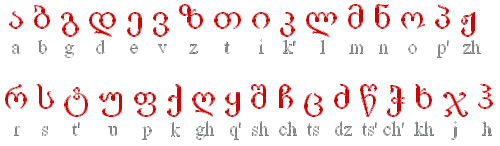
The Georgian language is a unique and incredibly difficult language. The alphabet looks like this -


I'm sure you're wondering how to differentiate between the K' and K, T' and T, and Ts' and Ts sounds, and I'm right there with you, not to mention that some of the sounds in the alphabet simply do not exist in English. So ya, this'll be fun. 

As for cross-cultural training, the Georgian culture can pretty much be summed up in one word - supra. Georgians love supras, or feasts, where obscene amounts of wine are consumed (at least by males). Georgia is the oldest wine growing region in the world and to say they love wine is an understatement. When Georgians plan supras, they usually plan for about 1 liter per guest. These supras can range from normal family dinners to large wedding or celebratory dinners, and they can last anywhere from 2-3 hours to 6+ hours. Each supra is led by a Tamada, or toastmaster. He says a toast, and then everyone drinks. As a male, I am obliged to drink every glass of wine ბოლომდე (bolomde), or "to the bottom." There is no casual sipping or drinking throughout the meal - you drink when the Tamada toasts, and you drink to the bottom of the glass, which is then immediately refilled in preparation for the next toast. Georgians also enjoy cha-cha, or homemade moonshine that's about 160 proof, which I've been strongly advised to stay away from at all costs. It's safe to say there is a lot of consumption going on, and I'm learning a variety of ways to politely excuse myself from having to drink as much as the Georgians. For all of my self-believed drinking prowess, I'm fairly certain the Georgians have me beat by a mile. 

Yesterday we had the honor of meeting and listening to the the United States Ambassador to Georgia, Richard Norland, as well as the Regional Security Director and the Political/Economics Deputy Chief. It was very interesting to hear them talk about Georgia's rapid development and future with regard to the EU and NATO.

Ambassador Norland

Last night we took our first trip outside of the training center into the town of Bazaleti. Here are a few pics:

"Marketi" = Market. Pretty much the only store in town, which has most of your basic needs from vodka to shaving cream.

Some kids clowning around
Bazaleti Lake

Tomorrow is our last day here in Bazaleti. We'll be split up and sent to various villages around the main town of Khashuri for our real training, which will last for about 11 weeks. I'll be living with a host family during this time and will be training with a small group of other volunteers, who will also each be with a host family of their own. The rest of the volunteers will be 15-30 minutes away and every so often we'll have training sessions with the full group. At the end of training I'll receive my permanent site placement as well as my permanent host family but there's lots to come before that happens, so don't go anywhere.

ნახვამდის for now